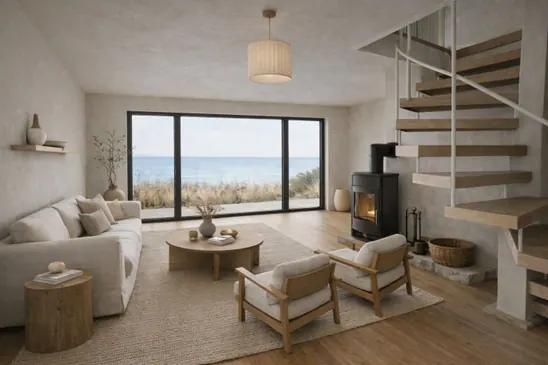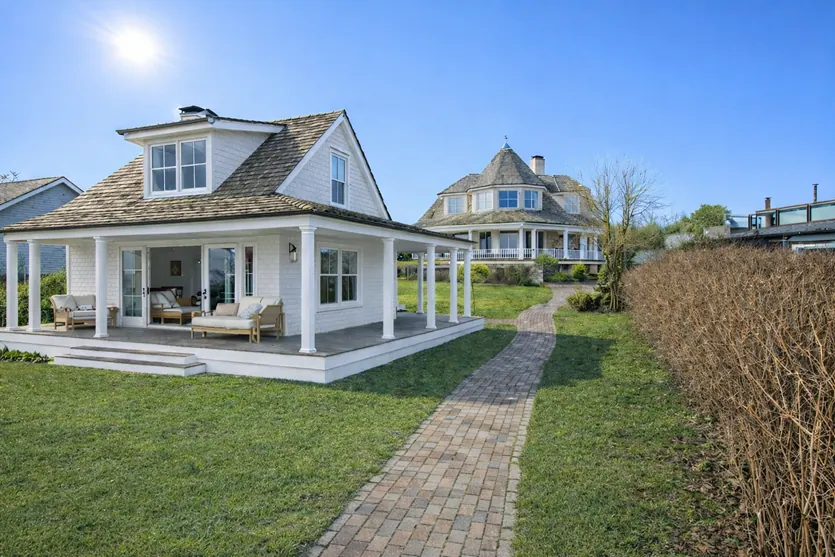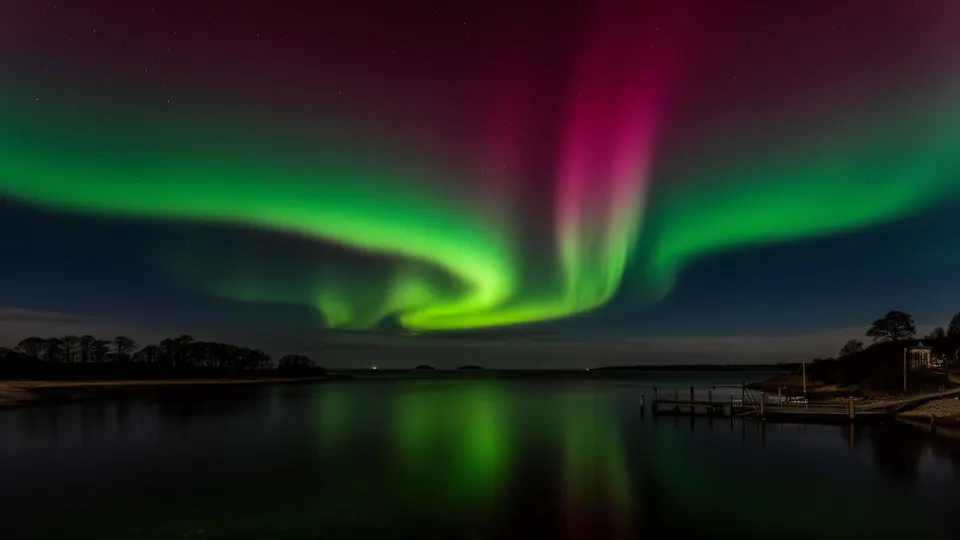
Most people associate the northern lights immediately with Norway, Iceland or Lapland. Yet since 2023 one thing is clear: the aurora is dancing over the Flensburg Fjord too — and at a frequency that hasn't been seen for decades. Several strong solar storms in recent years have pulled green, red and violet veils far south, well over Schleswig-Holstein and the Baltic. Anyone living with a clear view north over the water — as we do at Villa Boreal — has a decisive advantage.
What exactly are northern lights?
Northern lights (aurora borealis in the north, aurora australis in the south) appear when electrically charged particles from the sun — the solar wind — hit the earth's magnetic field. At an altitude of roughly 100 to 300 kilometres they excite oxygen and nitrogen atoms, which release their energy as coloured light: oxygen typically glows green and, higher up, red, while nitrogen shines violet to blue. Usually these lights are confined to a ring around the geomagnetic pole — the auroral oval. Only when a strong coronal mass ejection (CME) hits the earth does this ring expand far southward — and we get to see it down here too.
Why you can now see the aurora in northern Germany
The sun runs through an activity cycle of roughly eleven years. The current solar maximum of Cycle 25 was reached in 2024 and is expected to last into 2026 or 2027 — one of the most active phases in decades. During this time strong solar storms become more frequent, and with them the chance that the auroral oval reaches all the way down to Schleswig-Holstein. There is a second factor too: modern smartphone cameras now capture even faint auroras — barely visible to the naked eye — in clear green and magenta. A lot of what used to go unnoticed is now photographed, and the impression is growing that aurora over northern Germany isn't nearly as rare as we thought.
Spectacular sightings in recent years
Three events stand out. On the night of 10 May 2024 an extreme geomagnetic storm of class G5 — the strongest in over twenty years — triggered aurora worldwide; photos from Flensburg, Handewitt, Wanderup, from Holnis and from the Danish side near Kollund showed metre-high red and green columns straight above the fjord. In November and December 2023 the northern lights also danced repeatedly over Schleswig-Holstein, documented by NDR and the Neumünster observatory. And on the night of 21 January 2025 observers between Sylt, Flensburg and Kiel witnessed another colourful display — many rubbed their eyes in surprise, not expecting it this far south. Smaller, quieter outbursts in autumn 2024 and spring 2025 were photographed regularly too.
Watching from Villa Boreal
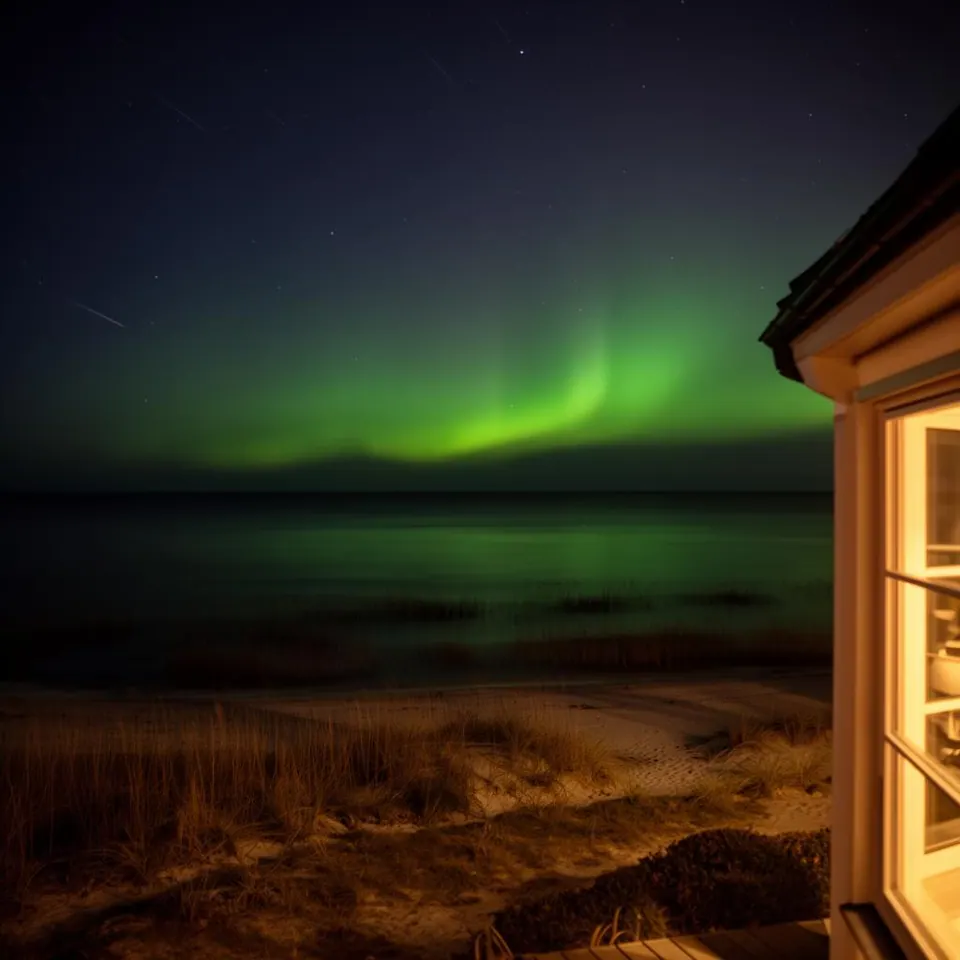
To see northern lights you need three things: a clear view north, as little light pollution as possible — and luck with solar activity. The Villa Boreal sits directly on the shore of the Flensburg Fjord with an unobstructed view north across the water, toward the Danish coast. Light pollution is markedly lower than in Flensburg city centre — an important prerequisite. When the sky is clear and a solar storm is forecast, the terrace by the water and the small beach in front of the house are two of the best front-row seats in the region. From the nearby Holnis peninsula (about five minutes by car) and the jetty in Bockholmwik you also have a wide view across the fjord — classic spots for astrophotographers from Flensburg and Sønderborg.
Practical tips: apps, weather, best time
The best season is September through April, when nights are long and dark enough. In summer it simply doesn't get dark enough in northern Germany. Useful tools are the apps „Polarlicht Vorhersage“, „My Aurora Forecast“, or the website of the US-American NOAA (Kp index): from Kp 6 it's worth looking up here, and from Kp 7 the aurora is usually visible to the naked eye. Important: let your eyes adapt to the dark for at least 15 minutes, switch your phone screen to red mode or put it away, and always take a test photo facing north — the camera often sees what the eye is only just starting to perceive. For photos a tripod, an 8–15 second exposure, ISO 1600–3200 and as fast a lens as you have are enough.
In short
What used to be a Scandinavian-only experience has, in recent years, become reality on the Flensburg Fjord — and is likely to remain so throughout the current solar maximum. With a little patience, a weather and aurora app and a night by the water, the chances of writing your own northern-lights story have rarely been so good. Anyone who has ever dreamed of seeing the aurora can now request a night with a view north — fittingly named after Aurora Borealis, the northern light itself.
See also our articles on the beaches of the Flensburg Fjord, the Holnis peninsula and on a winter holiday on the fjord.