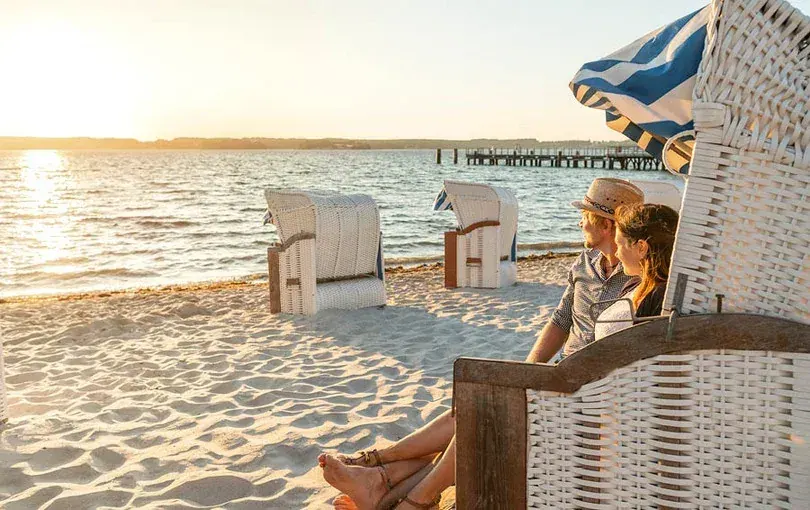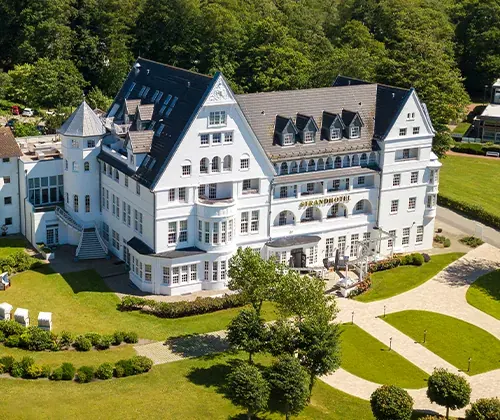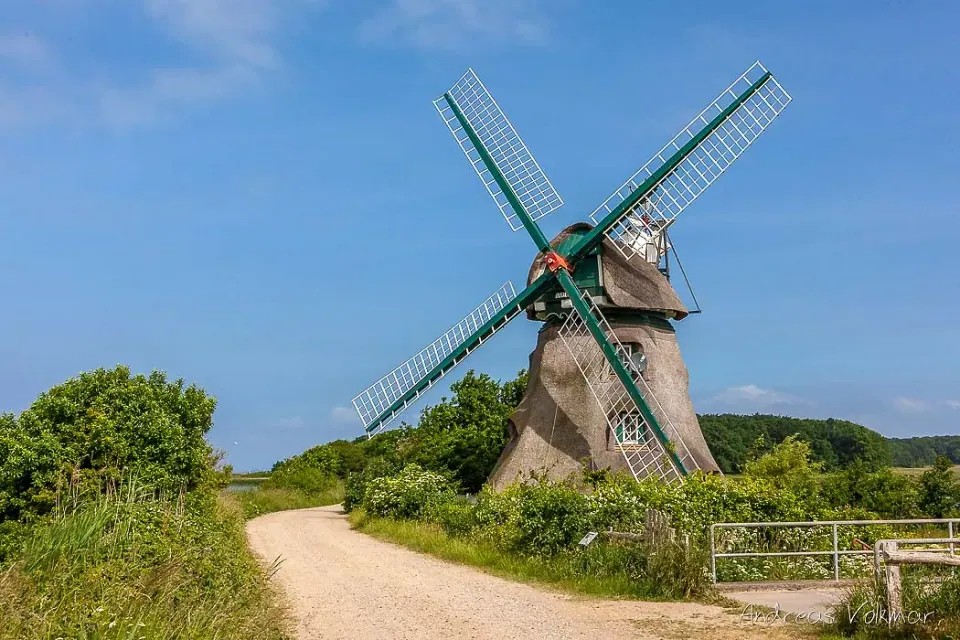
Angeln — a peninsula of only about 1,300 km², yet few regions in Northern Germany carry such world-historical weight. From here, in the 5th century, the Angles set sail for Britain and gave „Engl-and“ its name. A few kilometres south lies Hedeby, the largest Viking town in Northern Europe, protected by the mighty Danevirke. Between them winds the Schlei — Germany's only Baltic fjord — through gentle hills, thatched villages and herring weirs.
WHY ANGELN & SCHLEI?
Cradle of the Anglo-Saxons, home of the Vikings
The name „Angeln“ survives globally today: in „England“, in „Anglicanism“, in the „English language“. In the 5th century, the Angles, together with the Saxons and Jutes, left their homeland between the Schlei and Flensburg Fjord and settled in Britain. The Venerable Bede already wrote in the 8th century that „Angulus“ had remained deserted ever since — a region that founded a kingdom.
A few kilometres to the south lies Hedeby (Old Norse Heiðabýr) — from the 8th to the 11th century the largest and richest Viking town in Northern Europe, a hub between the Baltic, the North Sea and the Frankish Empire. It was protected by the Danevirke, Northern Europe's largest archaeological monument — today a UNESCO World Heritage Site. A day in Angeln and along the Schlei is a journey through 1,500 years of European history.
A day along the Schlei — Vikings, Angles, harbours
From 09:00 to 19:00 — a chronologically coherent west-to-east route
We start in Schleswig (Gottorf Castle & Hedeby), follow the Schlei downstream through the Schleswig Geest and thatched villages, and finish in Kappeln at the mouth of the Schlei. The route also makes chronological sense: it begins in the Viking Age (Hedeby, 9th c.) and ends in the baroque and maritime present of Kappeln.
DURATION
10 h
KM
~140
FOR
History lovers
Via the B199 to Schleswig
About 50 minutes via Glücksburg, the A7 southwards and the Schleswig/Schuby exit. In clear weather, a first stop at Gottorf Causeway with views of Gottorf Castle rising majestically from the castle lake is worth it.
Villa Boreal
Berglyk 8, 24960 GlücksburgRoute
Renaissance castle & state museum
Gottorf Castle was for centuries the residence of the Dukes of Schleswig-Holstein-Gottorf — and is today one of Northern Germany's most important museums. Inside: the Nydam Boat (4th c.), the Iron Age bog bodies and the Globe House replica. The collection alone is worth 2 hours.
Tip: A combined ticket Castle + Hedeby Viking Museum (approx. €14) is worthwhile — valid for 2 days.
Schloss Gottorf
Schlossinsel 1, 24837 SchleswigRoute
Heiðabýr — the Viking metropolis
Just 5 km south of Schleswig: the Viking Museum with a modern exhibition building and seven reconstructed Viking houses on the original site. The semicircular rampart (still 5 m high today) once enclosed a town of 1,500 inhabitants. UNESCO World Heritage Site since 2018.
Tip: From the parking lot it's a 1 km walk to the open-air museum — wear good shoes. Right in Busdorf by Hedeby: „Odins“ in the historic village inn from 1828 — regional cuisine, Viking pizza and a farm shop, ideal for an early bite.
Hedeby Viking Museum
Am Haddebyer Noor 5, 24866 BusdorfRoute
Senatorkroog or Brasserie Schleimöwe
Back to Schleswig for lunch. „Senatorkroog“ by the harbour serves fresh Schlei fish and Schleswig-Holstein classics, the „Brasserie Schleimöwe“ sits right by the water with views of the cathedral.
Tip: The Schleswig speciality: pan-fried herring from the Schlei with roast potatoes.
Senatorkroog
Rathausmarkt 9, 24837 SchleswigRoute
Fishermen's quarter „Holm“ or boat tour
Two options: a stroll through the Holm — the picturesque 14th-century fishermen's quarter with white houses around a cemetery island — one of the loveliest neighbourhoods in Northern Germany. Or a 90-minute Schlei cruise with the White Fleet.
Tip: Holm tip: the Holm Museum (free) shows the history of the fishermen's guild since 1650.
Holm Schleswig
Süderholmstraße, 24837 SchleswigRoute
Via the B201 along the Schlei
The 45 km route along the Schlei runs through gentle hills, thatched villages (Sieseby!) and past Louisenlund Palace. Worthwhile stops in Arnis (Germany's smallest town, 312 inhabitants) and Kappeln-Ellenberg. Food lovers plan a detour to Fleckeby to „Smager“ by Benjamin Spack — an organically certified game specialist (Monday game day) who reinterprets North German classics in a modern, seasonal way.
Tip: Sieseby is one of Schleswig-Holstein's prettiest villages — a short photo stop is worth it. If you want to eat at „Smager“, book ahead.
Sieseby
24351 Thumby (Sieseby)Route
Harbour, bascule bridge & historic herring weirs
Kappeln sits directly at the Schlei mouth — with a historic bascule bridge, marina and the last functioning herring weirs in Europe (trap fishing since the 15th century). The Dutch windmill „Amanda“ rises above the harbour — a perfect postcard motif.
Tip: The bascule bridge opens every full hour — a lovely spectacle with ship traffic.
Kappeln Harbour
Hafenstraße, 24376 KappelnRoute
Restaurant „Räuchereibesitzer Föh“ or „Aalkate“
Föh's smokery (since 1894!) is a Kappeln institution — freshly smoked Schlei eel, halibut and salmon straight from the in-house smoker. Alternative: the historic „Aalkate“ by the harbour with classic fish stew and Schlei herring.
Tip: Reservations recommended in summer — outdoor seats at the harbour are highly sought after.
Räucherei Föh
Schleswiger Straße 28, 24376 KappelnRoute
Home via the B201
Straight back via Süderbrarup and the B199 — arrival Villa Boreal around 20:30. On long summer evenings, a final stop at Schleimünde viewpoint with views over the river mouth into the Baltic is worth it.
Villa Boreal
Berglyk 8, 24960 GlücksburgRoute
HISTORICAL BACKGROUND
The Angles, the Saxons and the birth of England
In the 5th century AD, after the Romans withdrew from Britain, British tribal princes called on Germanic mercenaries for help — and Angles, Saxons and Jutes came in droves. The Angles from today's Schleswig-Holstein settled mainly in central and northern England (Mercia, Northumbria, East Anglia), the Saxons in the south (Wessex, Essex, Sussex), the Jutes in Kent. From their language, Old English, modern English evolved.
Traces of the emigration can still be found on the peninsula today: place names such as Süderbrarup, Norderbrarup, Boren or Karby have direct counterparts in Yorkshire and Norfolk. The name „Angeln“ itself lives on in the English kingdom — and in Roman Catholic liturgy as „Anglia“.
THE VIKING LEGACY
Hedeby, Danevirke & the Norse world trade
Hedeby was founded around 770 AD and rapidly developed into the most important trading place of the Viking Age. Up to 1,500 people lived within the semicircular rampart, still visible today. Coins from Baghdad, silk from Constantinople, amber from the Baltic, slaves, furs and iron were traded here.
The Danevirke — a 30 km fortification of earth, wood and later stone — secured the southern border of the Danish kingdom against Saxons and Franks. Built from 500 AD onwards and continually expanded into the 12th century, it is today a UNESCO World Heritage Site. Hedeby and Danevirke together formed the gate between Scandinavia and the continent — a node that made the entire Viking Age possible.
ARRIVE CAR-FREE
Through Angeln on the historic railway
Want to experience Angeln entirely without a car? In summer the Angeln Steam Railway runs historic Uerdingen railbuses every Saturday between Kappeln and Flensburg — from 30 May to 12 September 2026 (except 25 July). The nostalgic ride through the Angeln peninsula takes a good hour each way and stops in Scheggerott, Wagersrott, Süderbrarup, Sörup and Husby.
Departures from Kappeln are at 9:20 and 15:20, from Flensburg at 11:20 and 17:20 — so a complete car-free day trip is possible. The railbus can be used with the Deutschland-Ticket, the Schleswig-Holstein fare, the SH-Ticket or a student semester ticket. Note: the historic vehicles are not barrier-free, and bicycle carriage is only possible to a limited extent.
A JOURNEY BACK TO THE 1920s
By steam train from Kappeln to Süderbrarup
Unlike the railbus, the actual steam train is a genuine journey back in time: the Angeln Steam Railway runs passenger carriages from the 1920s — unique in Germany, nowhere else do original coaches of this era still roll. Already at Kappeln station the steam hisses from the valves, the fireman builds the fire, and with the conductor's whistle the train sets off just like 90 years ago. The line runs through the meadows and fields of Angeln — through blooming rapeseed fields in May — with stops in Scheggerott and Wagersrott, where you can stay seated with a coffee in your carriage.
In Wagersrott, right by the station, lies the Holländerhof village museum — the on-screen home of the „herbal doctor Hinnerksen“ from the German TV series „Der Landarzt“. The end point is the lovingly restored Süderbrarup station from 1904, where the points are still switched by hand. Just five minutes' walk away lies the Thorsberg Moor: a sacrificial site over 2,000 years old where weapons, shields and costume jewellery were laid down — the finds are on display today at Gottorf Castle, closing the circle back to the start of this tour.
Conclusion
Angeln and the Schlei are a living history book — from the kingdom named after the emigrants of this region to the UNESCO World Heritage Site of Hedeby. From Villa Boreal the most important stations are reachable in 30–60 minutes. Plan your stay on the fjord and discover the cradle of England on the German Baltic.