VILLA BOREAL · BOCKHOLM · FLENSBURGER FÖRDE
A Baltic Sea Winter —
The Fjord is Yours
While the wicker beach chairs are in storage and the summer guests have long returned to the city, the most honest season begins on the Flensburg Fjord. Empty beaches, dramatic light, steaming saunas, crackling fireplaces — and the water, still and steel-grey, holding a quiet promise. Winter here isn't for postcards. It's for those who know that silence is a luxury.
8 MIN READ
The Fjord in January — no beach chairs, no voices, just water and wind.
Why November to March is the most honest season
The Flensburg Fjord in high summer is a charming chaos: families with ice cream, sailboats, the click of beach chair locks. It’s beautiful. But it isn't honest. The fjord is a northern landscape, and it is most true to itself when the tourists have gone home.
From November to March, everything changes. The light becomes low and lateral, sometimes for just an hour, yet more golden than any summer day. The cliffs at Bockholm lie deserted. If anyone is on the beach, it's someone with a dog. The water is a still, steely grey — sometimes with thin sheets of ice on the groynes — and the sound is no longer of voices and plastic, but of wind and gulls.
The beach chairs are in storage. What remains is the bare coast: boulders, seaweed, polished pebbles. Anyone standing on the beach at Sandagermark at sunrise will understand why the Danes don't just survive winter, but savour it. It’s not about warm temperatures. It's about having nothing and no one between you and the landscape.
“In winter, the fjord is yours. No crowds, no queues — just water, wind, and fire.”
The house in winter
A beach house in winter is only a promise if it's built for it. Villa Boreal is. It wasn't designed for the twelve weeks of high summer, but for the long, dark months when Scandinavia truly begins.
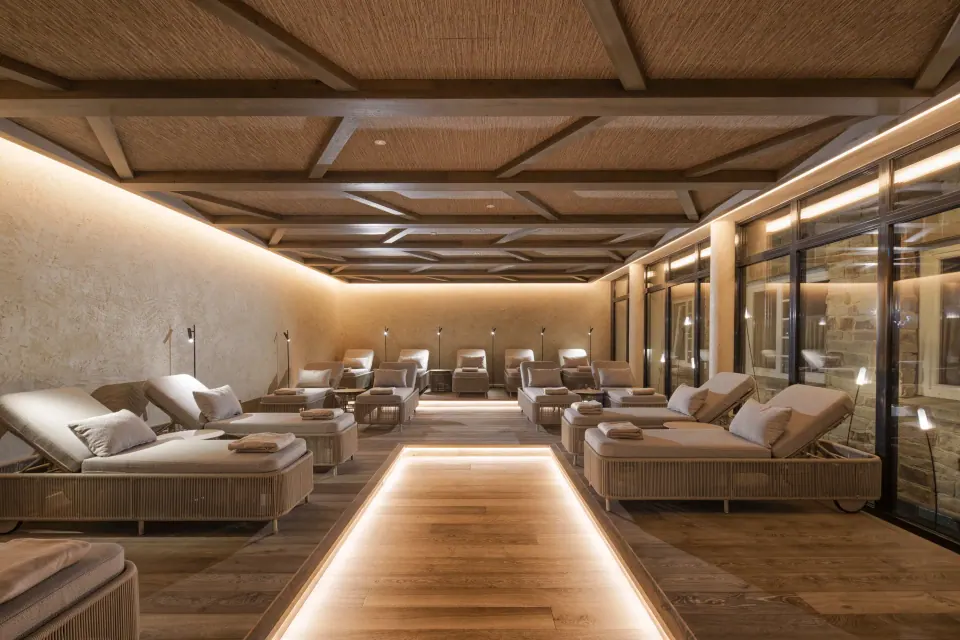
Inside, underfloor heating runs across all levels — no cold feet, no shivering when you get out of bed. In the living room, the tiled stove is lit; the wood is stored dry in the shed. The pool is heated year-round: 28 degrees, steaming, with a view of the fjord while the wind sweeps across the cliffs outside. Right next door is the sauna — Finnish, 90 degrees, with a birch infusion. The classic ritual: first heat up, then head down to the beach, dip your feet in the water, return for another infusion. Three rounds. Anyone who has done this once will never go south again.
In the beach house — the separate pavilion by the water — a second fireplace crackles. This is where you sit in the evening with a glass of wine, feet tucked into a woollen blanket, looking out at the lights of Holnis on the opposite shore. This isn't a holiday. It's a winter retreat.
💡 Tip: Stock up on birch wood from the Petersen farm shop in Munkbrarup. When it burns, it smells like a Swedish summer house — and it's worth its weight in gold during winter.
What to do in the off-season
The biggest myth about the fjord's off-season: “Nothing is open.” Wrong. The best places are open — just without the queues.
Schloss Glücksburg feels like a different place in winter. In summer, you wait in the courtyard for the next tour. In February, you can stand alone in the White Hall, the light slanting through the high windows, as the castellan tells stories simply because he has the time. The castle is open year-round (except for partial closures in December/January), and in November or March, it feels as if it’s there just for you.
Flensburg's old town is most authentically itself in the winter. The captains' houses by the harbour, the narrow courtyards of Norderstraße, the warehouses — everything feels denser, more secret when the light fades early and a lamp burns in every window. Restaurants like Borgerforeningen or Galwik will seat you without a reservation. Unthinkable in summer.
And the cycling: the paths are empty. On a clear day in January, the Fjord Cycle Path from Glücksburg to Holnis is one of Northern Germany's most beautiful routes — wind at your back, the fjord to your left, fields to your right, and no one but you. Easily done with an e-bike.
💡 Tip: In winter, get a window table at the Restaurant Schiffbrücke down by the harbour in Flensburg. As the ferry departs for Glücksburg, the lights glitter on the black water. Pair it with Labskaus or Matjes — it's the essence of Northern Germany.
Quiet events in winter
Winter on the fjord isn't loud, but it's not empty. It holds moments that summer simply cannot offer.
The Christmas market in Flensburg is small, Danish-influenced, with Glögg instead of Glühwein and a touch of Copenhagen. It clusters around Nordermarkt and Marienkirche, lasts only a couple of weeks, and in the late afternoon, as the string lights turn on and the harbour lies dark, it is one of the most beautiful in the country.
New Year's Eve on the villa's private jetty: sparkling wine, a woollen blanket, sparklers — and at midnight, the fireworks on the Danish side reflecting in the water. No crowds, no police, no unfamiliar voices. Just you and the fjord.
And finally: storm watching. When a westerly low-pressure system moves across the North Sea in mid-February, it funnels the water into the fjord. The waves then crash against the cliffs, the wind howls around the house, and from the first-floor balcony, you have a front-row seat. No app, no screen, nothing can replace it.
Rates & Availability
The off-season (November to March, excluding the Christmas and New Year's weeks) is not only the most honest time — it's also the most accessible. While the high season rate is 950 € per night, winter rates start at 500 € per night. The same house, the same pool, the same sauna, the same fjord — at half the price.
Minimum stay in winter: 3 nights. Enough time to arrive, complete a full sauna-beach-sauna cycle, spend a long day in Flensburg, and sit with a coffee by the water one last morning before you leave.
We are now accepting enquiries for the 2026/2027 winter season.
Your Winter Retreat on the Fjord
From 500 €/night, 3-night minimum stay. Sauna, pool, fireplace, private jetty — and a landscape that is all yours.
ENQUIRE ABOUT AVAILABILITYYOUR HOME BY THE SEA
Check availability