VILLA BOREAL · BERGLYK 8 · BOCKHOLM · FLENSBURGER FÖRDE
Glücksburg –
From the Cradle of Europe to a Baltic Seaside Resort
Over 800 years of history in a single place: Cistercian monks, dukes, tsars' daughters, steamships and ladies in long dresses. How a monastery hill on the Flensburg Fjord became the cradle of European royal houses – and then the most elegant seaside resort in northern Germany.
READING TIME APPROX. 12 MINUTES
The Beginnings – Stone Age, Vikings and the Rudekloster
The history of Glücksburg begins long before the castle and even long before Christianity. In the Friedeholz forest south-west of Holnis, megalithic tombs from the Neolithic era still stand today – silent witnesses to a settlement that reaches back at least 5,000 years. Stone Age people moved along the fjord, fishing, hunting and burying their dead in enormous granite blocks.
The actual founding story begins in the year 1209: Cistercian monks built a monastery on a small peninsula on the shore of the Flensburg Fjord – the Kloster Rus Regis, in Danish Rudekloster, in English the Monastery of Kings. The monks came from Sorø Monastery on Zealand, and their new house on the Angeln peninsula was to be both a bastion of faith and a centre of agriculture.
The ferry between Holnis and Brunsnæs was no mere fishermen's path: it connected the Rudekloster to the church in Broager, which the monks had to cross to regularly. One of the oldest documented ferry routes in the fjord region, already recorded in the 13th century.
Glücksburg in Numbers and Facts
The Castle – Duke Johann and 1,200 Cattle
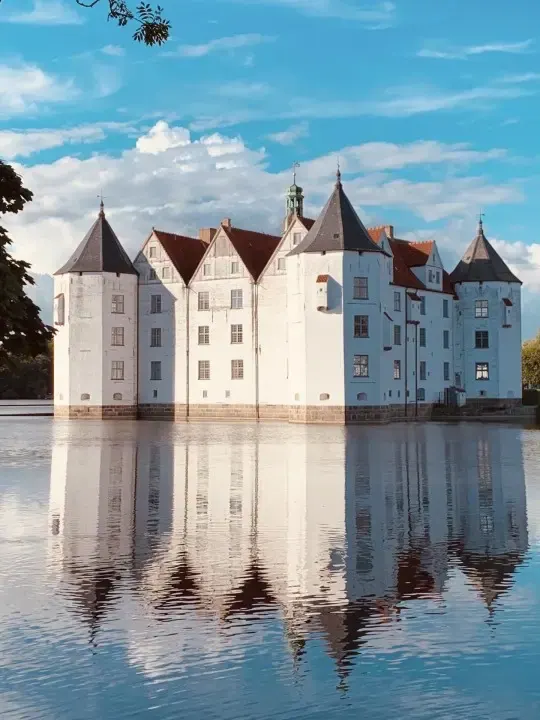
GLÜCKSBURG CASTLE · BUILT 1583–1587
In 1544, King Christian III of Denmark dissolved the Rudekloster during the Reformation and transferred the monastic estate to his brother, Duke Johann the Younger (1545–1622). This marks the decisive episode: a ducal builder with 23 children, a passion for architecture and the ambition to create a grand residence on the fjord.
Shortly before Christmas Eve 1582, Johann signed a contract with the master builder Nikolaus Karies: 6,000 Lübeck marks for the construction of a moated castle – roughly equivalent to the value of 1,200 cattle. The building material was around 800 years old; the castle itself was completed in just five years, between 1583 and 1587.
What emerged was extraordinary for the region: a square Renaissance castle measuring 30 × 30 metres, erected on a 2.5-metre-high granite plinth above the castle lake, flanked by four octagonal corner towers. Listed in German heritage protection to this day, described in the Michelin Guide as a 'white castle by the sea'.
God grant fortune with peace – the motto of Johann the Younger above the entrance portal. The initial letters of the Latin version gave the castle – and thus the town – its name.
Inscription above the entrance portal, Glücksburg Castle, 1587
The name Glücksburg derives directly from the duke's motto: Gott Gebe Glück mit Frieden (God Grant Fortune with Peace). Johann married twice – 14 children from his first marriage, 9 from the second – and was superbly connected: brother-in-law of the Elector of Saxony, recognised at the court of Emperor Maximilian II, brother of the Danish king.
A particular treasure of the castle is the richly coloured calfskin leather wall-hangings, probably made in a Mechelen workshop around 1680, which can still be seen in the state rooms today. The castle interior is largely preserved in its original form – a stroke of historical fortune.
The Dukes of Glücksburg – Five Generations
After the death of Johann the Younger in 1622, the small duchy was divided among his sons. His second-youngest son Philipp received the castle and estates of Glücksburg, founding the elder line of the House of Schleswig-Holstein-Sonderburg-Glücksburg. For the next 150 years, the castle served as the seat of five generations of dukes.
The Cradle of Europe – Christian IX and His Children
In the history of Europe, no castle has exerted such a far-reaching dynastic influence as little Glücksburg on the Flensburg Fjord. The reason lies in one man: Christian IX (1818–1906), who was called to the Danish throne in 1863 after the childless death of King Frederick VII.
He was called the father-in-law of Europe – and he fully earned the title. There was scarcely a royal house of the late 19th century that was not connected to Glücksburg.
The Children of Christian IX and Their Dynasties
From Glücksburg, the throne rooms of England, Russia, Greece and Norway were filled. When you stand on the beach at Bockholm today and look out across the fjord, you are looking at the waters that once bound these family ties together.
War, Prussia and the Family's Return
1864 brought the end of the long personal union between the Danish royal house and the Schleswig-Holstein duchies. During the Second Schleswig War, Glücksburg Castle served as quarters for Carl of Prussia, then as a field hospital and barracks.
On 16 September 1868, King Wilhelm I of Prussia visited the castle personally to decide its future. The decision was merciful: Wilhelm returned the castle to the family. In 1871, Duke Karl moved back into the castle – a return that has kept the castle in family ownership to this day.
📍 The 1920 plebiscite, after the First World War, was the last great political turning point: Glücksburg voted to remain with Germany. Since 1863, kings from the House of Schleswig-Holstein-Sonderburg-Glücksburg have reigned over Denmark.
The Seaside Resort – Steamers, Beach Chairs and Thomas Mann
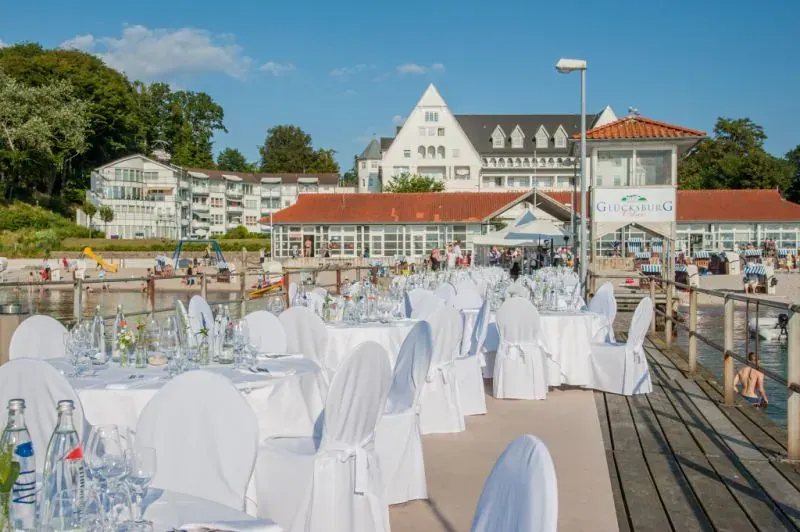
GLÜCKSBURG PIER · SINCE 1872
In the 1830s, a different story began: bathing operations in the Quellental, the first tentative attempt to establish Glücksburg as a health resort. But the real rise to seaside resort status only began after the war, in the early 1870s.
On 30 June 1872, the first Kurhaus opened on the beach at Sandwig. Six guest rooms, a year-round restaurant, a marquee for 500 guests. Steamers docked at the pier every hour.
The idyllic stretch of coast, with its pier and historic beach hotel, recalls the days when ladies still wore long dresses and took the steamer from Flensburg to Glücksburg for afternoon coffee.
From a travel guide to the Flensburg Fjord
In July 1873, the Kurhaus was expanded into the Strandhotel Glücksburg – 70 rooms, a large ballroom. It was the first building in Glücksburg to have a telephone connection. From Flensburg to Glücksburg in one hour, sitting comfortably on deck, the fjord on both sides.
The Strandhotel attracted celebrities from across northern Germany. Alfred Krupp came for sailing. Kaiser Wilhelm II steered his yacht 'Hohenzollern' towards the landing stage in 1890. Thomas Mann and his publisher Samuel Fischer were guests in 1919.
In 1885/86, the Flensburg–Kappeln railway line was opened. In 1900, Glücksburg was granted town charter. The elegant seaside resort was now officially a town.
📍 Today's Strandhotel Glücksburg still stands on the same foundations as the Kurhaus of 1872. The pier below leads to the fjord steamer MS Viking – the same route as 150 years ago.
Holnis – The Peninsula That Was Once an Island
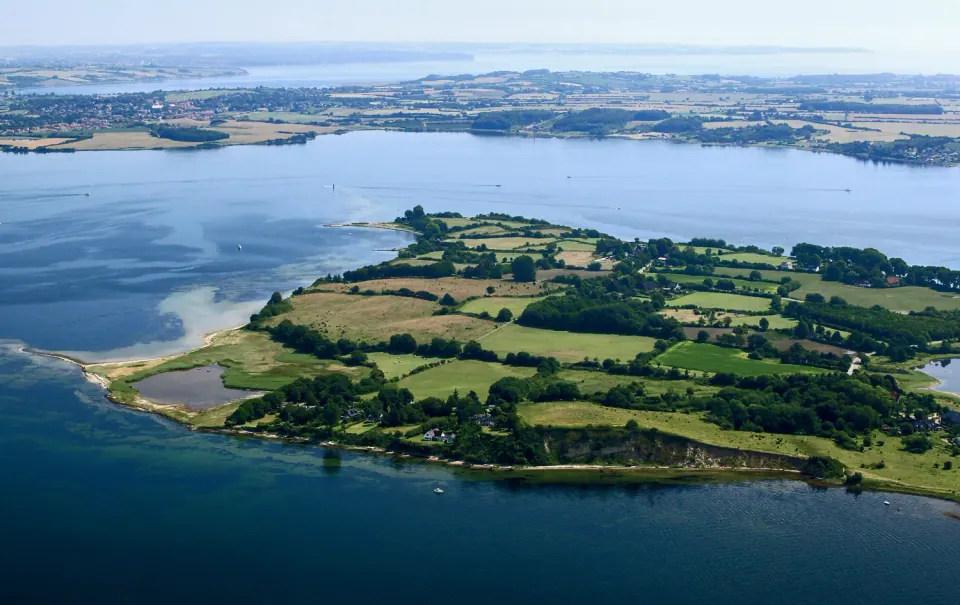
HOLNIS PENINSULA · NATURE RESERVE SINCE 1993
Anyone walking on the Holnis peninsula today is treading on a landscape that is physically younger than the castle. It was only between 1920 and 1928 that the great lagoon was dyked and pumped dry – transforming the peninsula into solid land for good.
The Kleine Noor tells the reverse story: in 2002, it was reflooded – creating a new 18-hectare body of water with saltwater influence. Today it is a rare saline biotope on the Baltic coast.
Brickworks – the Economic Backbone
For centuries, Holnis was a centre of the brick industry. At least three brickworks are documented: the Holnis Brickworks (from 1710), the Schausende Brickworks (from 1722) and a smaller one on the north shore. The bricks for the castle itself are said to have come from Holnis and Bockholm.
The Nature Reserve and Germany's Northeasternmost Point
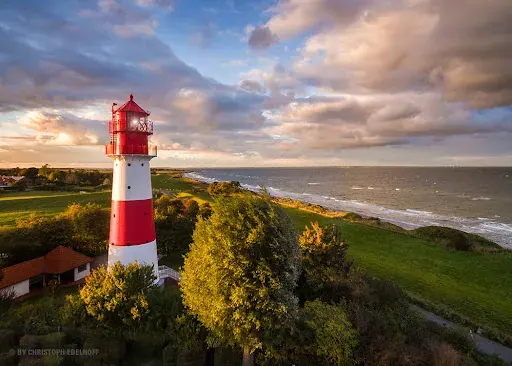
Since 1993, a 360-hectare section of Holnis has been a nature reserve. The northern tip of the peninsula is Germany's northeasternmost point on the mainland. At the tip stands the Holnis Lighthouse near Schausende – the northernmost lighthouse on the German Baltic coast.
📍 The Theodor-Fontane-Wanderweg trail runs across the Holnis peninsula. Those hiking the Fördesteig coastal trail pass through Holnis on Stage 5.
Bockholm – Bricks, Cannons and the Coastal Trail
Bockholm – in Danish Bogholm – lies immediately south-east of the Holnis peninsula, one kilometre east of the castle. The street name Berglyk means something like 'little hill' – and indeed, Bockholm sits on a gentle moraine ridge with unobstructed views across the fjord and towards Denmark.
At the end of the Alte Schulweg (Old School Road), right at the water's edge, stood the Osterziegelhof Bockholm – possibly one of the oldest brickworks sites in the entire region. At its peak, the entire coast had over 70 brickworks.
During the First Schleswig War of 1848, Bockholm became a frontline: Danish troops landed at the southern bridge; from a hilltop in Bockholm – the Johannisberg – a German battery fired on the ships. Two houses burned down.
The Fördesteig – Bockholm as a Hiking Destination
Today, Bockholm is a waypoint on the Fördesteig, the 95-kilometre coastal walking trail. Stage 6 leads from Bockholm via Bockholmwik and the Siegum forest to Langballigau – roughly 7 kilometres of nature trail directly along the cliff coast.
📍 Berglyk 8, Bockholm – the address of Villa Boreal – lies directly on the Fördesteig. The trail literally passes by the villa.
Glücksburg Today – The Legacy Lives On
Glücksburg Castle remains in the possession of the Dukes of Schleswig-Holstein-Glücksburg. Since 1922, a foundation has managed the ensemble; today it is a museum and year-round event venue – a stage for the Schleswig-Holstein Music Festival, a setting for concerts and civil wedding ceremonies.
The town has just under 6,500 inhabitants and is the northernmost town in Germany.
The Holnis peninsula, under nature protection since 1993, is today one of the most valuable biotopes on the Schleswig-Holstein Baltic coast. Marina Holnis was supposed to become a hotel and apartment complex with a yacht harbour for 500 vessels – the plan failed. What remains is the silence.
God grant fortune with peace. The motto that a duke had carved above his gate over 400 years ago still describes this stretch of coast better than any modern marketing.
When you look out from Berglyk 8 across the Flensburg Fjord, you are looking at the same coastline that once belonged to the Rudekloster, inspired dukes, accompanied kings' daughters and delighted holidaymakers in long skirts. The water is the same. The view towards Denmark is the same. The stillness of the early morning has not changed its character in 800 years.
History to feel, not just read.
Villa Boreal is located at Berglyk 8, Bockholm – directly on the Fördesteig coastal trail, on the hilltop above the fjord, with a view across 800 years of history.
CHECK AVAILABILITYMORE FROM THIS CATEGORY
Similar guides
RELATED JOURNAL STORIES
Further reading
YOUR HOME BY THE SEA
Check availability