VILLA BOREAL · BERGLYK 8 · BOCKHOLM · FLENSBURGER FÖRDE
Holnis Peninsula —
The northernmost piece of mainland Germany
A peninsula reaching into the Flensburg Fjord — 360 hectares of nature reserve, brackish water, kite spot, hiking paradise and views all the way to Denmark. The complete guide to Holnis, five minutes from Villa Boreal.
READING TIME APPROX. 14 MINUTES
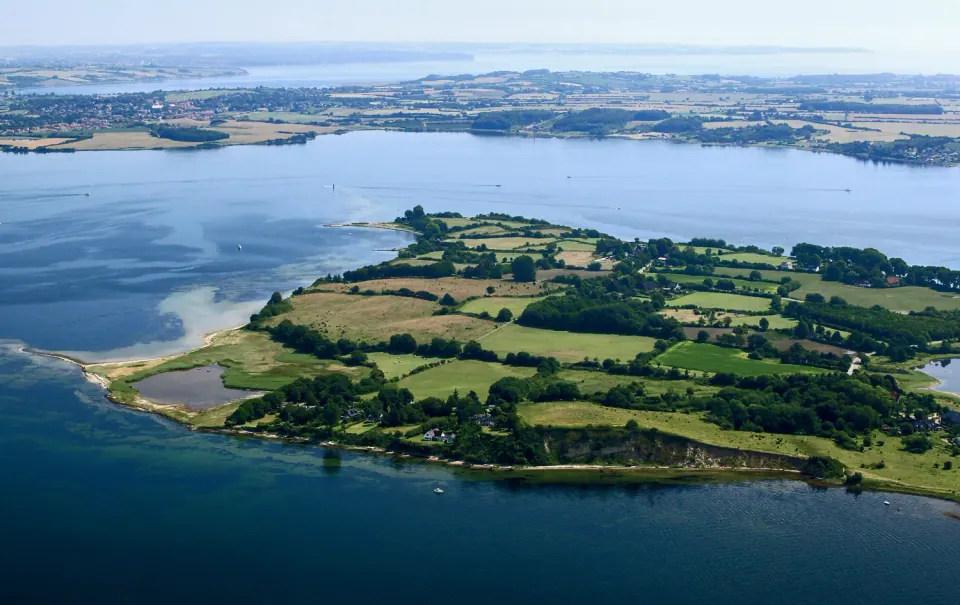
The Holnis peninsula from above — Geltinger Bay on the left, the open fjord on the right, Denmark on the horizon.
What makes Holnis special
The Holnis peninsula is a geographical detail you barely notice on a map — and never forget once you've stood on it. It reaches almost three kilometres into the Flensburg Fjord and ends at the northernmost point of the German mainland. Not an island, but very nearly one. Open fjord on one side, the still brackish water of Geltinger Bay on the other. And on the horizon, always visible: the cliffs of Sønderjylland in Denmark.
What makes Holnis special is the combination of silence and drama. Silence, because there is no promenade here, no beach bar with bass, no rental bikes with bells. Drama, because the water works on the peninsula from three sides, because the lark in spring can actually still be heard, because in October the harbour porpoises surface between Holnis and the Danish coast.
Since 1993, 360 hectares have been under nature protection — almost the entire peninsula north of the Drei–Bockholmwik line. Which means: no building, no widening of paths, no dogs on the beach in summer. Which in turn means: Holnis today looks almost exactly as it did a hundred years ago.
Holnis in numbers
The nature reserve — geology, flora, fauna
Cliff edge on the northern coast — the terminal moraine drops up to 17 m to the fjord.
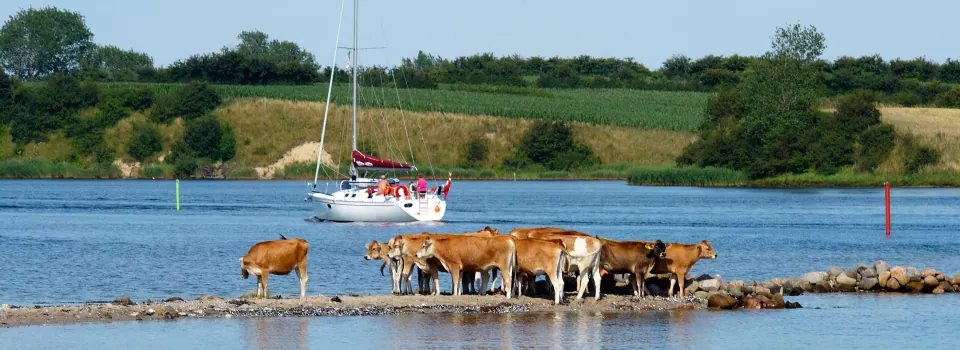
Geologically, Holnis is a gift of the last ice age. The glaciers left a terminal moraine ridge here, whose steep edges you walk along on the northern coast paths today — the pale clay and sand cliffs drop up to 17 metres to the fjord. In a strong storm, a piece breaks off regularly. The coast changes — slowly, but visibly.
The flora is a mix of coastal heath, salt grassland and scattered dune remnants. In early summer, sea pinks, sea lavender and Carthusian pinks bloom between the grasses. The wild roses along the path date back to the 1920s — planted to bind the sand. Today they are a trademark.
Birds are the actual reason for the protected status. Holnis lies on the migration route between Scandinavia and central Europe. In spring and autumn, great crested grebes, red-throated divers, eiders and ringed plovers rest here. Anyone scanning the water with binoculars in the early morning regularly sees harbour porpoises too — the only whale species native to the Baltic. With luck, a seal glides past the tip in autumn.
📍 Important: in the nature reserve (north of the peninsula) dogs must be on a leash year-round. On Holnis Drei and Bockholmwik beaches, dogs are forbidden from May to September. Off-season the beach is free.
The beaches — Holnis Drei, Bockholmwik, the tip
Holnis Drei — the shallowest entry on the entire fjord, perfect for families.
Holnis has three very different beaches — and that is the peninsula's quiet strength. There is no "best" beach. There is the right beach for the day, the weather and the mood.
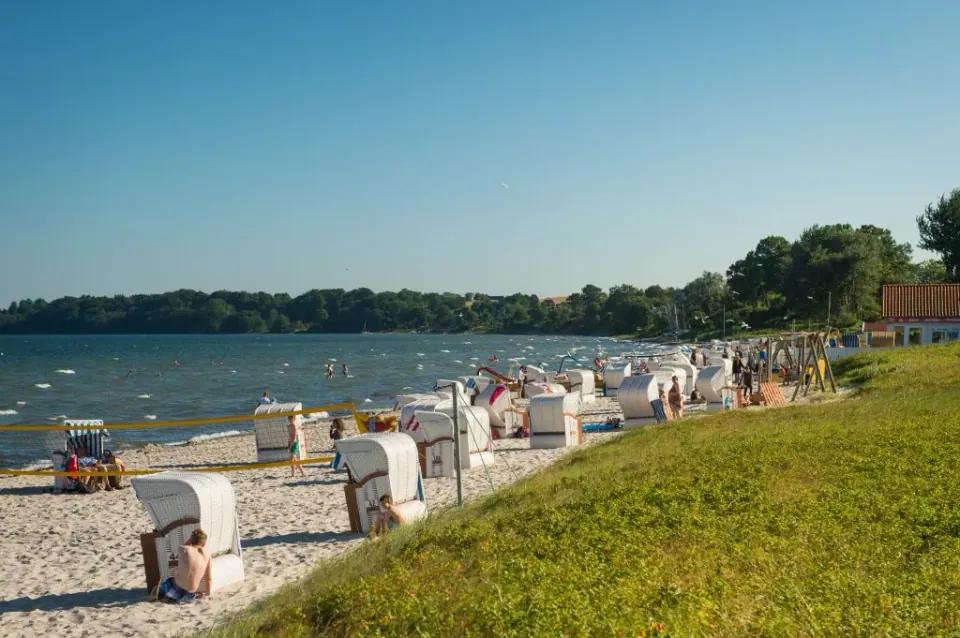
Holnis Drei is the family beach. Kilometres long, soft sand, very shallow entry — children can wade out far. In season there are beach chairs (rented on site), a small kiosk sells ice cream, fries and coffee. Sundays in summer get full, so: arrive before 10am or after 4pm.
Bockholmwik is the kite beach. The wind turns NW and SW across the open fjord here — the Surf- und Kiteschule Holnis has its base right by the water, rents equipment and runs courses for beginners. If you only come to watch: on good days there are 30 kites in the air at once.
The Holnis tip has no infrastructure, no nearby parking, no kiosk. You walk the last 800 metres along a footpath. Reward: a wild stone beach at high tide, a narrow sand strip at low tide, and the unobstructed view across the water to Brunsnæs on the Danish side. This is the favourite spot of everyone who knows Holnis.
Anyone staying at Villa Boreal has the fastest access of all three: Bockholmwik is 800 metres away, the private jetty in the bay is the quietest option.
The three beaches at a glance
At the tip of Holnis the noise stops. Denmark is 4 km away — you can smell it.
Watersports — kiting, surfing, SUP, kayak
Holnis is one of the most established kite and surf spots on the western Baltic — for a simple reason: the geometry of the peninsula means that with almost any wind direction there is flat water somewhere.
The Surf- und Kiteschule Holnis sits directly on Bockholmwik beach. They rent boards, kites, harnesses and wetsuits, run beginner courses (two days, around €250), and are the central point for everything wind-related. Booking via holnis-kite.de.
SUP works best in the wind-sheltered bay between Bockholm and Holnis Drei — flat, calm water, perfect for beginners. With NW wind the fjord lies smooth, with SW it can chop up. Boards available from the kite school or the rental at the jetty.
Kayak: The route from Bockholmwik to the tip and back is a classic half-day trip (around 8 km, 2–3 hours). For more, paddle on towards Geltinger Birk — one of the most beautiful natural coasts of the German Baltic.
Best wind directions for kiting: NW (clean wind across the open fjord) and SW (offshore, smooth water, ideal for tricks). With N and NE it gets tight — better to switch to the Geltinger side then.
Hiking on Holnis — loops and the Fördesteig
Hiking on Holnis is the most effortless way to make the peninsula your own. There is an official Holnis loop (about 7 km, 2 hours, flat) that connects all three beaches, the nature reserve and the tip. Start and end: car park Holnis Drei. Marking: white H on a green background.
The route runs first through the coastal heath, then along the high cliff edge with views to Denmark, down to the tip, and back along the still brackish water on the western side. May–June is when the heath is most colourful, September when it is warmest lit. Sturdy shoes are enough — no mountain trail, but sandy in places.
For more, link the loop to the Fördesteig. The trail runs from Glücksburg via Bockholm and Holnis to Geltinger Birk — 32 km in total, walkable in stages. The Bockholm–Holnis stretch (about 5 km) is considered the most beautiful section of the whole route. Here you walk along the top of the cliff, the view opens at every bend.
From the entrance of Villa Boreal you reach the Fördesteig in 10 minutes on foot. The cliff walk north of Bockholm — one of the most popular micro-routes — practically starts at the door.
📍 Tip: do not enter the high grass northeast of the footpath at the tip — ground-nesting birds (ringed plover, lark) breed there from April to July.
Food & drink on Holnis
Holnis is not the place for fine dining. It is the place for an ice cream after a swim, for a fish roll after a hike, for a coffee with wind in your face. That is exactly what makes it right.
Strandcafé Holnis sits right on Holnis Drei, in a small wooden building with a terrace facing the water. Breakfast, cake, a small menu with fried potatoes, fish rolls, pasta. Open seasonally (April–October), full on summer weekends — booking pays off.
Holnis Drei kiosk right on the beach: ice cream, fries, coffee, lemonade. No seating, all to go. Open May to September, longer in good weather.
Bock 19 in Bockholmwik is the best stop after a hike — a small, honest fish shack in the harbour, fresh smoked fish straight off the cutter, fish rolls, beer on tap. Open year-round (limited in winter). Three minutes' walk from Villa Boreal.
For dinner indoors, Glücksburg is ten minutes by car — restaurant tips are in the restaurant guide.
Practical info — getting there, parking, season
Holnis works best when you know the small rules — otherwise you stand at 11am in summer without a parking spot.
Getting there: By car from Glücksburg on the main road heading north (Holnisstraße), signposted "Holnis". From Villa Boreal: 5 minutes by car, 15 minutes by bike along the Fördesteig (highly recommended — more beautiful than the direct route).
Parking: Three paid car parks — Holnis Drei (large, full by 10am in July/August), Bockholmwik (small, almost always full in summer) and the tip (very small, only 15 spaces). Day ticket around €5, often cheaper with the Förde-Card. Tip: from 4pm there is space everywhere.
Season: Best time for hiking and birds: April–June and September–October. Best time for swimming: July–August (water 18–21°C). Best time for kiting: spring and autumn (more wind). Best time for silence: November–March — the tip belongs almost only to the wind and the gulls then.
Dogs: In the nature reserve, on a leash year-round. On Holnis Drei and Bockholmwik beaches, forbidden May to September, otherwise free. For guests with dogs: the private jetty of Villa Boreal is the year-round alternative.
What to bring: Wind always comes from somewhere — even in midsummer a light jacket is wise. Sturdy shoes for the trails. Binoculars for birds and porpoises. Water, because there is a lot of open ground between the kiosks.
More from the region
All beaches
Overview of every beach on the fjord
Hiking & cycling
Fördesteig and loops
Sailing & surfing
Kite, SUP and watersports
History of Glücksburg
Castle, spa & 800 years next to Holnis
Glücksburg Forest
600 ha of forest, lakes & dolmen trail
Guided tours & film town
Filming locations, promenade & tours
Holnis on the doorstep. Villa Boreal.
Five minutes to the tip. Private jetty in the bay. Four bedrooms, pool, sauna, beach house.
CHECK AVAILABILITYMORE FROM THIS CATEGORY
Similar guides
YOUR HOME BY THE SEA
Check availability