VILLA BOREAL · BERGLYK 8 · BOCKHOLM · FLENSBURGER FÖRDE
Flensburg –
Rum, Lions
and Two Nations
From a Danish trading settlement to a Prussian border town, from Caribbean rum in merchant courtyards to the last government of the Reich in Mürwik: the story of a city between two cultures that remains both Danish and German to this day.
READING TIME APPROX. 18 MINUTES
The Founding – a Danish Trading Town
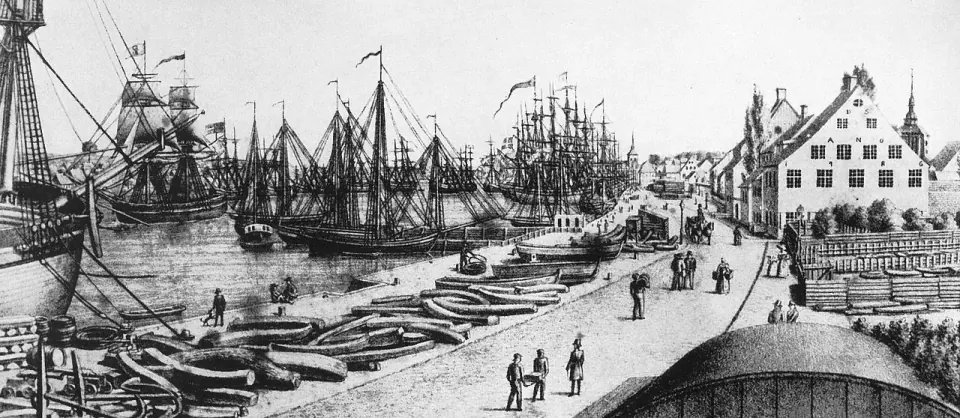
At the head of a 35-kilometre fjord, where the approach to the Baltic meets the trade routes to Jutland, Angeln and Frisia, a small trading settlement emerged in the 12th century. It belonged to the Kingdom of Denmark and grew quickly: merchants, fishermen and craftsmen settled along the shores of the fjord.
In 1240, Flensburg received its first documentary mention – in a deed of donation to the Johannis monastery. In 1284, King Erik Menved granted the settlement its town charter under Lübeck law. This marked the start of its rise: Flensburg became the most important harbour between Lübeck and Bergen, a transhipment point for herring, salt and grain.
A dramatic date: on 28 October 1411, Queen Margarethe I – founder of the Kalmar Union, which united Denmark, Norway and Sweden – died on a ship in Flensburg harbour. The most powerful woman in Scandinavia breathed her last at this fjord.
High above the town stood the Duburg – a mighty hilltop castle built in the 15th century by the Danish dukes as a residence and administrative seat. It was not merely a fortress but also the birthplace of a king: on 15 April 1646, Christian V was born here, later King of Denmark and Norway (1670–1699). A Flensburger on the Danish throne – testimony to how closely the town was bound to the Crown. The Duburg was demolished around 1719; today the street name Burgberg and the Danish Duborg-Skolen keep its memory alive.
Just a few kilometres to the east, on the shore of the fjord, another aristocratic seat of European significance arose in the 16th century: Glücksburg Castle (1582–1587), one of the most important moated castles in northern Europe. It became the ancestral seat of the House of Schleswig-Holstein-Sonderburg-Glücksburg, a dynasty that still occupies the thrones of Denmark, Norway and Greece today. For centuries, Flensburg and Glücksburg formed a shared sphere of royal power.
Flensburg in Numbers and Facts
The Coat of Arms – Two Lions and the Nettle Leaves
Flensburg's town coat of arms is one of the oldest in Schleswig-Holstein, dating back to the 14th century. It shows two golden lions on a blue field – the lions of the Danish royal arms – flanked by nine red hearts (actually nettle leaves, an ancient Nordic symbol).
The coat of arms tells a story of allegiance: the lions point to the Danish Crown, the nettle leaves to Schleswig. Later, a bar bearing the Schleswig-Holstein nettle leaf was added. To this day, Flensburg carries both symbols – a visual testament to its dual identity.
The coat of arms is also a manifesto: Flensburg was never solely German or solely Danish, but always both. The two lions face in opposite directions – one to the north, the other to the south.
Between Denmark and Germany
From its founding until 1864 – for over 600 years – Flensburg belonged to the Danish realm. Not as a peripheral territory, but as the second-largest city in the Danish composite state after Copenhagen. In the 16th century, Flensburg was at times larger than the capital itself.
The Treaty of Ribe (1460) sealed the bond: Schleswig and Holstein were to remain 'up ewig ungedeelt' – forever undivided – linked to the Danish Crown. A promise that held for 400 years and then ended in bloodshed.
In the Second Schleswig War of 1864, Prussian and Austrian troops marched in. Flensburg fell to Prussia. Overnight, the second-largest city in Denmark became the northernmost city in Prussia. Street names were Germanised, school instruction switched to German. Yet the Danish identity did not vanish – it merely grew quieter.
📍 The Danish minority in Flensburg still accounts for about 20% of the population. There are Danish schools, a Danish newspaper (Flensborg Avis), a Danish library and a Danish cultural centre (Flensborghus). Bilingualism remains part of everyday life.
Merchant Courtyards – the Herringbone City
Perhaps the most distinctive architectural feature of Flensburg is its merchant courtyards – those long, narrow plots stretching from the main street to the harbour that give the old town its characteristic herringbone structure.
A single chain of streets – today Holm, Große Straße and Norderstraße – opened up the waterfront. As many plots as possible were to face both the street and the harbour, so that goods could be transferred directly from ship to warehouse. This produced the narrow plots, up to 100 metres deep.
Each merchant courtyard was a world of its own: at the front, the representative dwelling on the street; behind it, offices, warehouses, stables, workshops; and at the very back, the quay on the water. The courtyards were accessed through arched gateways – some lavishly decorated, others plain.
Today, around 30 merchant courtyards survive and are open to the public. Flensburger Hofkultur has turned them into a walkable city tour: small galleries, cafés, craft workshops and museums have made their home in the historic walls.
Step through the gateways of Flensburg's merchant courtyards and you enter a hidden city behind the city – quiet inner yards, warehouses and cobblestones that have remained unchanged for centuries.
Rum, Sugar and the Colonial Shadow
Flensburg's most exotic chapter began while the town still belonged to Denmark. In the 18th century, the Danish Crown maintained colonies in the Caribbean – the islands of St Thomas, St John and St Croix (today's US Virgin Islands). Flensburg merchants sailed out with ships laden with textiles, tools and ironware – and returned with raw sugar, rum and molasses.
In 1755, the Neptunus brought the first documented cargo of rum to Flensburg. It was the start of a trade that would fundamentally shape the town. At the height of the 19th century, Flensburg had over 200 rum houses – distilleries, warehouses and blending operations.
What the Flensburg merchants made from Caribbean raw rum was an art of its own: the Flensburger Rum-Verschnitt – a blend of Caribbean rum with neutral spirit and secret spice additions – became a regional speciality. The 'Pharisäer', a coffee with rum hidden beneath a cream topping, remains the fjord's most famous drink to this day.
Today, two historic rum manufactories survive: A.H. Johannsen (founded 1878) and Braasch (founded 1855). The Rum Museum in the Maritime Museum tells the complete story – including the dark side: the triangular trade, the plantations and enslavement.
📍 Flensburg confronts its colonial past more actively today than in the past. The Maritime Museum presents a nuanced exhibition on the triangular trade, and several street names with colonial references have been critically contextualised.
Brick, Gables and the Nordertor
Flensburg's architecture speaks of prosperity, trade and north-German sobriety. The townscape is defined by Brick Gothic, Renaissance gables and the characteristic stepped gable houses lining the harbour.
The Nordertor, built in 1595, is the town's landmark and one of the last surviving town gates in Schleswig-Holstein. The massive brick structure with its stepped gable and town coat of arms once marked the northern city limit. Anyone passing through the Nordertor was leaving town – heading for Denmark.
St Mary's Church (Marienkirche), with its mighty brick tower dating from the 12th century, is the oldest church in town. Together with St Nicholas's and St John's, it forms an ensemble of north-German Brick Gothic that is rare in this density.
Particularly worth seeing are the Kompagnietor facade at the harbour (1602) – once the seat of Flensburg's shipowners' guild – and Oluf-Samson-Gang, the narrowest lane in town with its tiny fishermen's cottages. In contrast stand the grand bourgeois villas in Mürwik and Solitüde, built in the late 19th century as summer residences for wealthy shipowners and merchants.
Naval Academy Mürwik and the Last Government
In the district of Mürwik, high above the fjord, stands a brick building of imposing bulk: the Naval Academy Mürwik (MSM), built between 1907 and 1910, modelled on the Marienburg in West Prussia. Since its inauguration it has served as the officer school of the German Navy – without interruption, through the Empire, the Weimar Republic, the Nazi era and the Bundeswehr.
In May 1945, the Naval Academy became the last seat of government of the German Reich. After Hitler's suicide on 30 April, his political testament designated Grand Admiral Karl Dönitz as successor. Dönitz relocated the caretaker Reich government to the Naval Academy and the neighbouring district. From 2 to 23 May 1945, Flensburg-Mürwik was effectively the capital of the collapsing Reich.
On 8 May 1945, Colonel-General Jodl signed the unconditional surrender. The Dönitz government continued to exist for another 15 days, until British troops dissolved it on 23 May and arrested its members – on the grounds of the Naval Academy.
Today the MSM remains a training facility for the Navy and also houses the Naval Command (formerly Fleet Command). A memorial within the school documents the history of the Dönitz government. The MSM is not open to the public but can be visited during guided tours and on open days.
Flensburg was not chosen; it was left over. It was the last place the Allies had not yet occupied. That the end of the Third Reich was sealed here of all places is an irony of history.
1920 – the Plebiscite
After the First World War and the Treaty of Versailles, the future of Schleswig was decided by plebiscites. On 14 March 1920, the population of 'Zone I' (North Schleswig) voted overwhelmingly for Denmark. On 14 April 1920, 'Zone II' (Central Schleswig, including Flensburg) followed: 75.2% voted to remain with Germany.
The result was clear-cut, but it left a Danish minority on the German side and a German minority on the Danish side. Both minorities exist to this day and enjoy special protection under the Bonn–Copenhagen Declarations of 1955.
As a monumental token of gratitude for the vote, the Weimar Republic erected the 'Deutsches Haus' (German House) in Flensburg – an imposing brick building in the New Objectivity style, inaugurated in 1930. The inscription above the portal read: 'Reichs Dank für Deutsche Treue' (The Reich's thanks for German loyalty). The building was intended as a cultural centre for the German population and a political statement: Flensburg is German and will remain so.
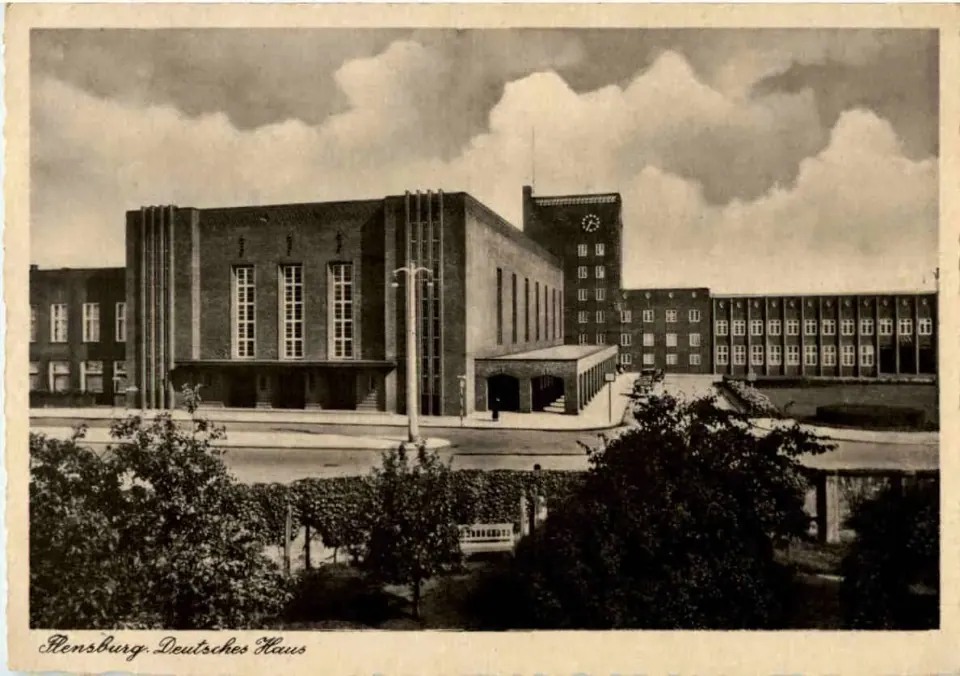
Today the Deutsches Haus is one of Flensburg's most important event venues. Concerts, theatre, congresses and exhibitions take place in its halls. The political charge has given way to pragmatic use – yet the name and architecture recall a time when a plebiscite decided the fate of an entire region.
In Flensburg, the Danish minority is part of everyday life: Danish schools, kindergartens, churches, associations and the daily newspaper Flensborg Avis (founded 1869) shape the townscape. The South Schleswig Voters' Association (SSW), the political representation of the minority, has been represented in the German Bundestag for the first time since 2022.
📍 In Flensburg, people greet each other with 'Moin' – a word that is neither distinctly German nor Danish, but Low German. It fits perfectly with a town that never had to choose.
Health Resort and Baltic Seaside Spas
Flensburg's districts of Solitüde and Mürwik developed into sought-after resort areas in the late 19th century. The seaside resort of Solitüde, named after the small palace of the same name, offered fine sandy beaches, a promenade and beach chairs – a Nordic counterpart to the fashionable resorts of the Bay of Lübeck.
Along the fjord promenade in Mürwik and Solitüde, grand bourgeois villas, guest houses and hotels sprang up. The town's wealthy merchant families built summer residences here with views across the fjord to the Danish coast. Many of these villas still stand today and define the character of the neighbourhoods.
Volkspark Mürwik was laid out as a recreation area; the Naval Academy itself – for all its military rigour – added to the prestige of the district. During the interwar years, Mürwik was one of the most desirable residential areas in Schleswig-Holstein.
To this day, the fjord promenade is served by the MS Viking – a fjord steamer that continues the tradition of the excursion steamers plying between Flensburg and Glücksburg since the 1870s.
Flensburg Today – a Border Town with Character
Flensburg today has around 92,000 inhabitants and is the third-largest town in Schleswig-Holstein. It is home to the Europa-Universität (founded in 1946 as a teacher training college), the Federal Motor Transport Authority (since 1951) and the Naval Command of the Bundeswehr.
The shopping mile along Große Straße and Holm is one of the longest pedestrian zones in Germany. The Galerie Flensburg and the lively Rote Straße with its artisan courtyards complement the shopping experience. At the harbour tip, a modern cultural quarter has developed around the Maritime Museum, the museum harbour and restaurants.
The proximity to Denmark is ever-present: cross-border shopping, Danish hot-dog stands, smørrebrød shops and bilingual street signs are constant reminders that Flensburg has never been solely a German city – and still isn't.
Flensburg is the only town in Germany where you can drink Caribbean rum, eat Danish smørrebrød, stroll through Hanseatic merchant courtyards – and be there in 20 minutes from Villa Boreal.
Looking westward from Berglyk 8, you see the skyline of Flensburg at the head of the fjord – the church spires, the Naval Academy, the harbour. The same silhouette that has greeted seafarers, merchants and kings for 800 years.
Flensburg Timeline
More Tips for Your Stay
800 Years of History –
20 minutes away.
From Villa Boreal you can reach Flensburg's historic old town, the merchant courtyards and the rum manufactories in 20 minutes. History you can touch – right from your doorstep.
CHECK AVAILABILITYMORE FROM THIS CATEGORY
Similar guides
YOUR HOME BY THE SEA
Check availability