Flensburg's old town hides one of the loveliest courtyard cultures in northern Germany. Behind the gabled houses of Große Straße and Holm, around 30 historic merchant courtyards open up — quiet inner courts with brick warehouses, workshops and today cafés, galleries and small manufactories. Walking the courtyards is the most beautiful way to discover Flensburg beyond the main streets.
History — from West Indies trade to listed monuments
The courtyards were built between the 16th and 19th centuries, when Flensburg was one of the most important port cities of the Danish kingdom. Behind narrow residential and shop houses on the main street, merchants built warehouses and living quarters around protected inner courts — space for horses, wagons and barrels of rum, sugar and tobacco from the West Indies. The courts were the city's economic centres, giving merchants discretion and room within the dense old-town fabric.
When the West Indies trade declined at the end of the 19th century, many courtyards lost their original function. Only in the 1970s did a broad restoration movement begin. Today most courts are listed monuments, publicly accessible, and define the unique face of Flensburg's old town.
What the courtyards hold today
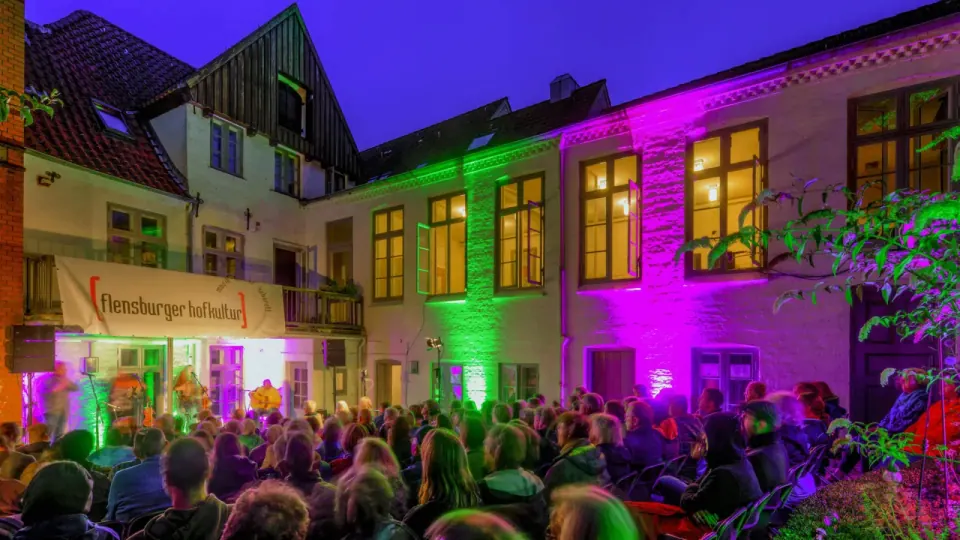
Specialty coffee roasters, bookshops, goldsmiths, small manufactories, galleries for contemporary art, quiet courtyard cafés and live-in studios — the courts are a vibrant slice of city culture. They link Holm and Große Straße to the parallel Marienstraße and the harbour, work as continuous passages, and become small stages in summer for concerts, readings and exhibitions.
Highlights — the loveliest courts
Roter Hof (Holm 35) with café and galleries · Westindienspeicher (Rote Straße 22), an imposing brick warehouse · Borgerforeningen-Hof, home to Flensburg's oldest Danish association · Robbe-Hof and Heller-Hof with lovingly restored half-timbered façades · the Oluf-Samson-Gang as one of the oldest preserved residential lanes in the city. Around 28 courts in total are restored, signposted and accessible from the main streets — easy to fill several hours.
Practical tips for visitors
The best time for a courtyard walk is late morning to early afternoon (10 a.m.–3 p.m.), when the cafés are open and the light in the inner courts is at its softest. In May the city hosts the annual „Flensburger Höfefest“ with live music, crafts and costumed tours — the most beautiful day to experience the courts in one go. Guided tours are offered by the tourist office at Nikolaikirchhof; printed route maps are free.
Half a day that stays with you
Guests of the Villa Boreal are 15 minutes by car from Flensburg's old town — the courtyards make a perfect half day between rum tasting, gallery visit and a coffee in an inner court. Now check availability and plan an old-town day.
See also our pieces on the history of Flensburg and the breweries & rum tradition.